of homebuyers say a developer's online reputation directly influences their purchase decision
Brand reputation in real estate is not a communications function — it is a sales function
JLL Global Real Estate Transparency Index 2025
of homebuyers say a developer's online reputation directly influences their purchase decision
Brand reputation in real estate is not a communications function — it is a sales function
JLL Global Real Estate Transparency Index 2025
Today’s homebuyers are more informed, more vocal, and more legally empowered than any previous generation of property buyers. A possession delay complaint posted publicly reaches thousands of prospective buyers — the same buyers a developer is counting on for their next project launch. A viral thread about a broken promise can shape booking velocity at a launch happening months later. In real estate, homebuyer trust is a sales-critical asset. Locobuzz protects it.
of real estate brand trust crises originate from unresolved social media complaints — not formal regulatory filings
CBRE Global Investor Intentions Survey 2025
luxury homebuyers research developers across social media and property review platforms before visiting a show flat
Edelman Trust Barometer Real Estate 2025
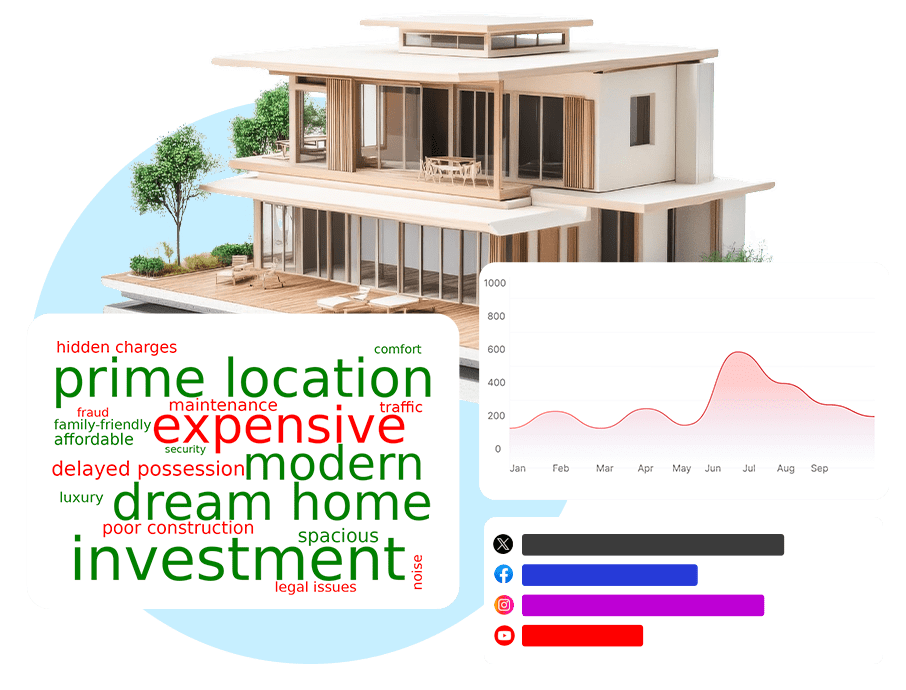
One real estate developer brand reputation platform — real-time homebuyer complaint management that intercepts issues before they escalate, agentic AI for real estate CX that routes every complaint to the right team instantly, and project launch sentiment monitoring that gives your marketing team live intelligence during the critical first 72 hours of a new launch.
A developer’s social media reputation is now part of the purchase decision — not just the post-purchase experience. Homebuyers compare developers on review platforms, research complaint histories in community forums, and take buyer experience posts seriously before committing to six- or seven-figure purchases. In competitive property markets where buyers have multiple options from credible developers, the brand that resolves complaints transparently and quickly doesn’t just retain buyers — it wins new ones. Homebuyer trust is the competitive differentiator that marketing budgets alone can’t create.

A homebuyer who receives their keys late doesn't just file a formal complaint — they post on social media, share in community groups, and leave detailed negative reviews on property portals. Each post reaches future buyers for that developer's next project, often for years.
Project launch sentiment monitoring isn't optional — launch buzz determines whether the first-week narrative is shaped by your marketing team or by sceptics and competitor commentary in buyer communities and property forums.
Every unresolved social media complaint is a potential regulatory escalation. With property consumer protection rules tightening globally, the gap between a public social media post and a formal regulatory complaint has narrowed dramatically.
Real estate influencers and broker communities shape buyer perception at scale. Without real estate influencer monitoring, developers have no visibility into whether influencer content is building or eroding brand trust among their target buyer segment.
Post-possession resident complaints about construction quality, amenity delivery, and maintenance standards generate long-tail negative content that continues affecting a developer's real estate developer brand reputation years after project completion — and surfaces in searches by prospective buyers at every future launch.

In real estate, reputation is built project by project, complaint by complaint, and review by review. Six engines — each mapped to a specific moment where homebuyer trust is won or lost.
Every brand mention, project name, developer comparison, and possession delay complaint across 20+ channels — including social media, property review portals, and buyer community forums. The real estate social listening tool that gives your marketing and CX teams full visibility into the homebuyer conversation — including the buyer community dynamics and review threads that directly influence your next project's booking velocity.
Real estate responses to homebuyer complaints carry legal and reputational weight simultaneously. A response that acknowledges a possession delay while inadvertently making a new commitment creates liability. ResponseGenie™ drafts responses that are genuinely empathetic, accurate about project timelines, and appropriately cautious — homebuyer trust maintained without creating new legal risk.
Powered by agentic AI for real estate CX. Every inbound complaint — possession delay, construction quality, amenity dispute, maintenance concern, regulatory escalation signal — classified and routed to the right team instantly. No homebuyer complaint sits unaddressed in a general inbox while the thread builds publicly.
Cluster of possession delay complaints at one project — construction financing issue, regulatory approval bottleneck, or contractor quality failure? ContextualPulse™ identifies which. For project launch events, it analyses whether early buyer concerns are concentrated in a specific buyer segment — enabling targeted messaging adjustments within the critical launch window.
Detects predictive homebuyer churn signals — buyers discussing cancellation in community groups, coordinated group complaint discussions — 30–60 days before formal action. Surfaces competitive acquisition windows when a rival developer's complaint surge creates an opening among buyers reconsidering their options.
Pre-configure project launch complaint management workflows before launch day. Regulatory escalation risk alerts fire automatically when complaint patterns reach defined thresholds — giving your legal and customer relations team an intervention window before formal proceedings begin.
Real deployments. Verified numbers.
Common questions from brand, marketing, and customer relations leaders evaluating Locobuzz for real estate.


Our team will get in touch with you shortly
Personal data will be processed in accordance with Locobuzz’s Privacy Policy