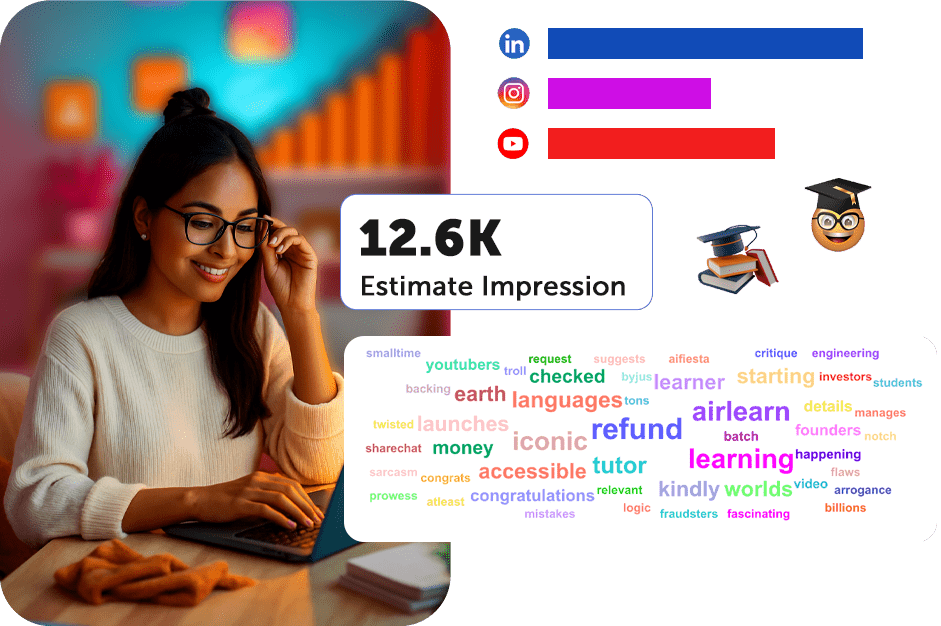
of EdTech users who experienced a trust issue — refund delay, course quality gap, or broken promise — shared that experience publicly
Trust events become enrolment events in hours
EDUCAUSE Student Experience Survey 2025
of EdTech users who experienced a trust issue — refund delay, course quality gap, or broken promise — shared that experience publicly
Trust events become enrolment events in hours
EDUCAUSE Student Experience Survey 2025
EdTech has learned its hardest lessons in recent years. Refund complaints went viral. Student trust collapsed overnight. Brands that had built credibility over years watched it erode in weeks — not because of product failures, but because the conversation got away from them. The education sector is in a rebuild phase, and reputation is the currency that determines whether an EdTech brand, coaching institute, or university grows its enrolment or watches it decline. Locobuzz keeps you ahead of that conversation.
Global education technology market by 2030 — growing at 16.5% CAGR
HolonIQ Global EdTech Report 2025
of prospective students say a brand's online reputation is a top-three factor in their enrolment decision
Qualtrics Higher Education Survey 2025
One education brand reputation management platform — real-time student sentiment analysis from Reddit to YouTube comment sections, agentic AI for EdTech student experience that routes every complaint to the right team instantly, and EdTech refund complaint management workflows that contain a crisis before it shapes the next enrolment window.
The competitive landscape makes this harder every year. Students trust peers, alumni, creators, and online communities more than official marketing. A single viral complaint, refund post, or honest course review can influence enrolment faster than a major ad campaign. For education brands, trust isn’t just perception — it directly shapes whether enrolment grows or declines, one conversation at a time.

EdTech refund complaint posts are among the highest-velocity trust events in any consumer category. When students share screenshots of denied refunds or broken payment promises, the posts spread rapidly through student communities — and the window to respond closes fast.
Education influencers and YouTube educators with large followings shape student trust more powerfully than advertising. Without ed-influencer sentiment monitoring, brands have no visibility into whether that influence is building or damaging enrolment intent.
Application and admission seasons are critical for enrolment. A negative sentiment spike or unmanaged complaint during the enrolment season directly affects admissions — with consequences that take months to recover from.
Students don't always escalate loudly before they leave. They compare platforms publicly, post course quality frustrations, and slowly disengage. Predictive student churn signal detection catches these patterns before they show up in completion rate data.
When a competitor EdTech brand launches a campaign, generates controversy, or faces a refund complaint surge, the competitive window to respond or reposition is hours — not days. Without structured EdTech competitive intelligence social listening, brands react after the conversation has already moved.

In education, the consequences of an unmanaged complaint aren't measured in refund amounts — they're measured in enrolment decisions, institutional reputation, and the trust that determines whether students recommend or warn others. Six engines, each built for a specific moment in the student trust cycle.
Every student complaint, alumni review, faculty mention, and competitor reference across 20+ channels — including Reddit student communities, YouTube comment sections, and education forums where prospective students do their real research. The EdTech social listening tool that covers the conversations your marketing team isn't watching.
In education, how you respond to a student complaint carries more weight than almost any marketing message. A dismissive reply to a refund complaint gets screenshotted and shared. ResponseGenie™ drafts responses that are transparent, empathetic, and aligned with institutional values — maintaining student trust quality even at 10x volume during enrolment season.
Powered by agentic AI for EdTech student experience. Every inbound complaint — EdTech refund complaint, course quality concern, faculty grievance, technical platform issue, placement outcome complaint — classified and routed to the right team instantly.
Refund complaint cluster — payment gateway failure or a systemic policy trust concern? Negative reviews concentrated in one cohort — course delivery gap or broad platform dissatisfaction? ContextualPulse™ makes the distinction. Student sentiment analysis that changes institutional decisions, not just response templates.
Detects predictive student churn signal patterns 30–60 days before they show up in completion rate data — students comparing platforms, declining engagement from specific cohorts, parent community sentiment shifts. Also surfaces competitive acquisition windows when a rival platform's refund complaint surge creates an opening among dissatisfied learners.
Pre-configure enrolment season complaint management and EdTech refund complaint crisis workflows before the critical windows begin. Crisis Mode activates automatically when complaint volume spikes — pre-approved responses deploy within minutes. Manage 10x normal volume. Same team. No SLA breaches.
Real deployments. Verified numbers.
Common questions from brand, admissions, and student experience leaders evaluating Locobuzz for education.


Our team will get in touch with you shortly
Personal data will be processed in accordance with Locobuzz’s Privacy Policy